|
24-hour Daylight in the Arctic and Antarctica
Facts
During much of the summer in the Arctic, the sun stays above the horizon for 24 hours per day giving continuous daylight. For example in Svalbard, Norway, there is sunshine at midnight from 19th April until 23rd August each year (reference). In the northern winter, the sun has moved south, towards the Tropic of Capricorn. When it is summer in the southern hemisphere, the most southern latitudes also experiennce 24 hours of sunlight per day. This was challenged by staunch flat earth believers, who accepted the challenge to go to Antarctica. They were forced to accept this fact. See the Wikipedia aerticle on this event.
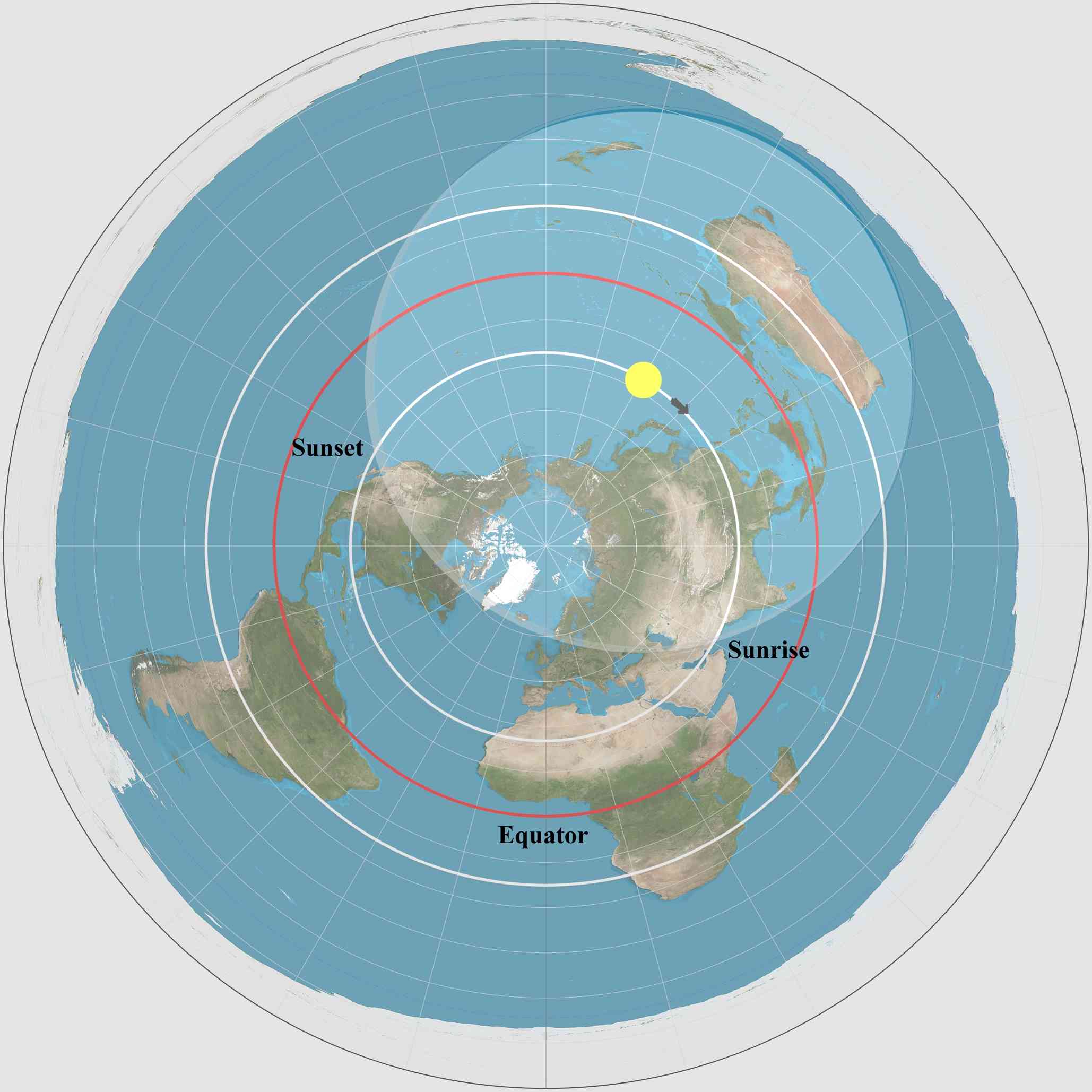
As the sun is traveling to the Tropic of Cancer in the northern summer, this can be explained o a flat earth model, as in the diagram below. The Tropic of Cancer is the inner white circle. The position of the sun is marked with the yellow dot. The area illuminated by the sun is represented by the pale circle around it. With the sun close to, or over the Tropic of Cancer, the sun can shine over the Arctic for 24 hours per day, until the sun moves closer to the equator. The flat earth model allows for Antarctica to have 24 hour periods of night until the sun has moved further south.
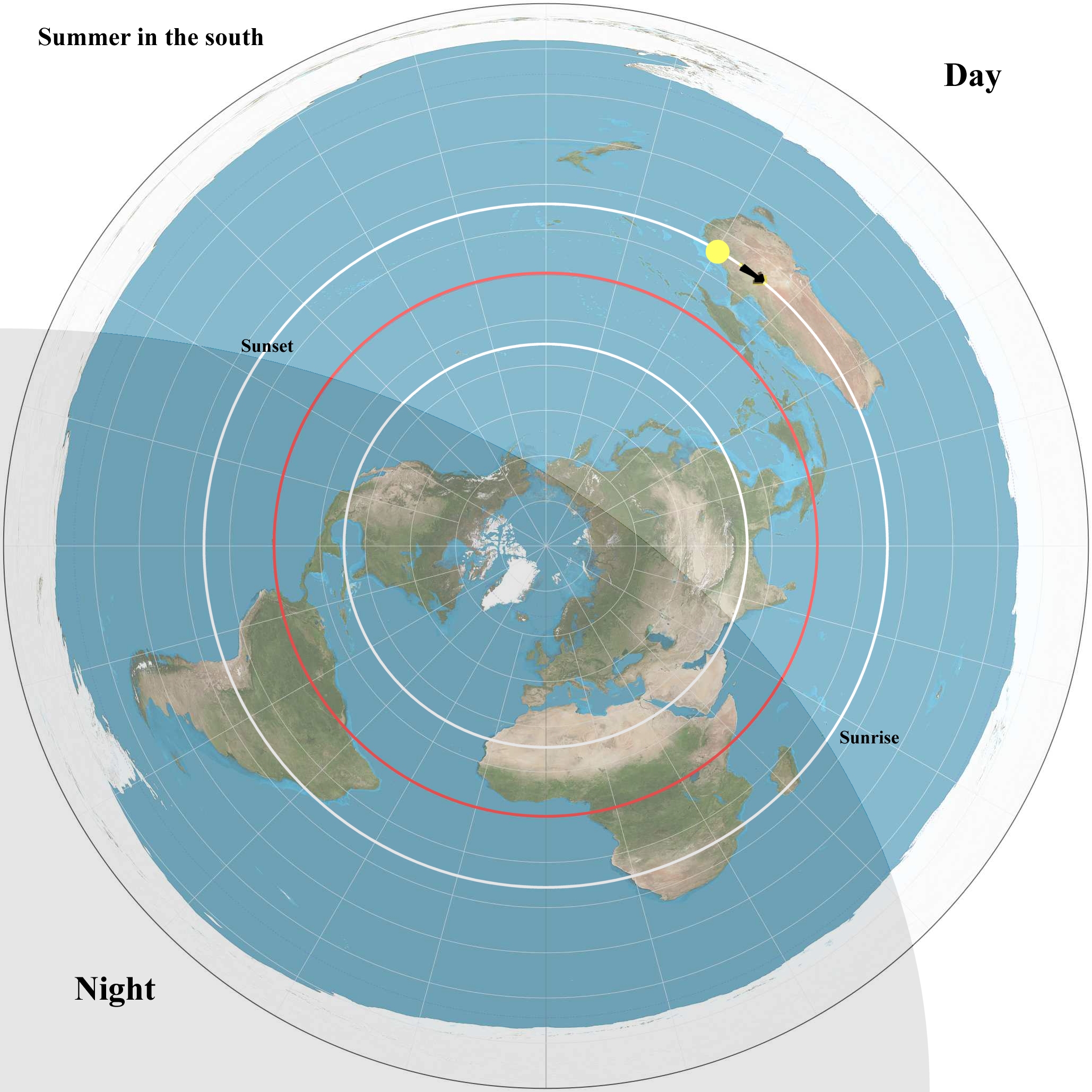
The problem for the flat earth model is that it cannot explain how the 24 hour daylight can occur in Antarctica. See the diagram below. The outer white circle is the Tropic of Capricorn. The pale zone represents the area illuminated by the sun. The Arctic is not illuminated and therefore can experience 24 hour long nights. However, it does not matter where the observer is in Antarctica, on the flat earth model, as the sun rotates around the world, Antarctica will experience day and night. This is not what happens in the real world.
The flat earth model fails to explain what happens in real life. It is therefore incorrect.
Back to homepage
|