|
Proof of the Earth's Curvature
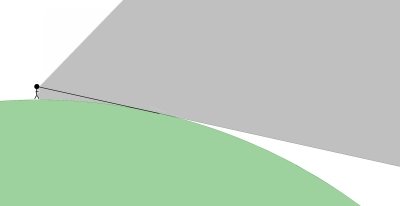
The simplest evidence of a spherical earth is the observation that the ocean is not flat. An observer standing at the beach sees an horizon at about 5km (3 miles). This is because the ocean curves out of view (see diagram 1). It is not because that is the limit of vision. Flat earthers will have to agree, given that they can see the sun rise each morninng, which by their maps has to be about 10,000km away.
The diagram below shows what is visible to an observer (the grey areas) standing at the beach on the surface of a curved earth. This canot be explained by saying that light is refracted and curves downward to give this appearance, as refraction occurs with changes in density of the medium through which light travels. Whilst there is a small, gradual change in density with elevation, light traveling at eye level does not encounter this, that is to say that light at this level encounnters a constant density in the air and hence no significant refraction.
Diagram 1.
 Anyone can verify that one can see much further at a higher elevation. As a birdwatcher, I know that I can see further out to sea by observing from a nearby cliff. Sailors of old knew this. That is why they had crows-nest lookouts on their tall ships. The effect, also, is readily seen by looking out the window of an airplane. On the ground one can hardly see past the airport. Once in the air the field of view increases dramatically as the plane ascends. Amateur rockets fitted with GoPros show the same. It is illustrated below in diagram 2.
Diagram 2
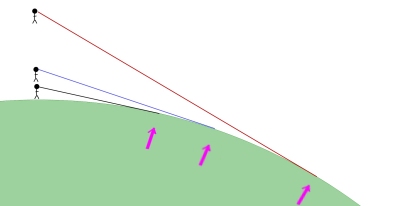
In the flat earth model, the observer should be able to see for thousands of kilometres. This, however is not the case.
Diagram 3

There is a limit to vision. This is not distance but resolution. The human eye can resolve detail to about one sixtieth of a degree in the field of vision. This means that at 1m the eye can resolve to less than a third of a millimetre. The table below shows the limit of resolution for varying viewing distances:
| Distance |
Maximum resolution |
| 1m |
0.29mm |
| 10m |
2.91mm |
| 1km |
290mm |
| 10km |
2.91m |
| 100km |
29.1m |
| 1,000km |
291m |
| 2,212km |
640m |
This chart is based on simple trigonometry where resolution width (w) is distance (d) times sine of the angle of resolution (A).
| sin A = w/d |
| w = d x sin A where A = 0.0167deg therefore |
| w = d x 0.000291 where A = 0.0167deg |
2,212km is the distance from Sydney, Australia to Mt Cook in New Zealand. Mt Cook is 3,724m in elevation, clearly far in excess of the 640m resolution. Therefore, if the earth were flat, Mt Cook should be clearly visible from Sydney. However, according to Google, the view of Mt Cook is lost at a distannce of 218km at sea. This can be explained by the curvature of the ocean.
The curvature of the oceans is most clearly observed with the arrival amd departure of large ships. As illustrated in the photos below (1 to 4) the first part of the ship to be visible is the highest point and as the ship comes closer, more and more of it becomes visble until the whole hull becomes visible. I have seen this many a time from a nearby port. Using magification does not make the effect disappear. As can be seen below, photo 1 is mmore magnified tha photo 4. It is easy to verify and hence no-one can claim that this does not occur. It cannot be explained by saying that it is an optical effect caused refraction.
 Based on an image produced by Dropus and released to Wikipedia Commons under the Creative Commons Attribution-Share Alike 4.0 International license.
Return to home page
|
